
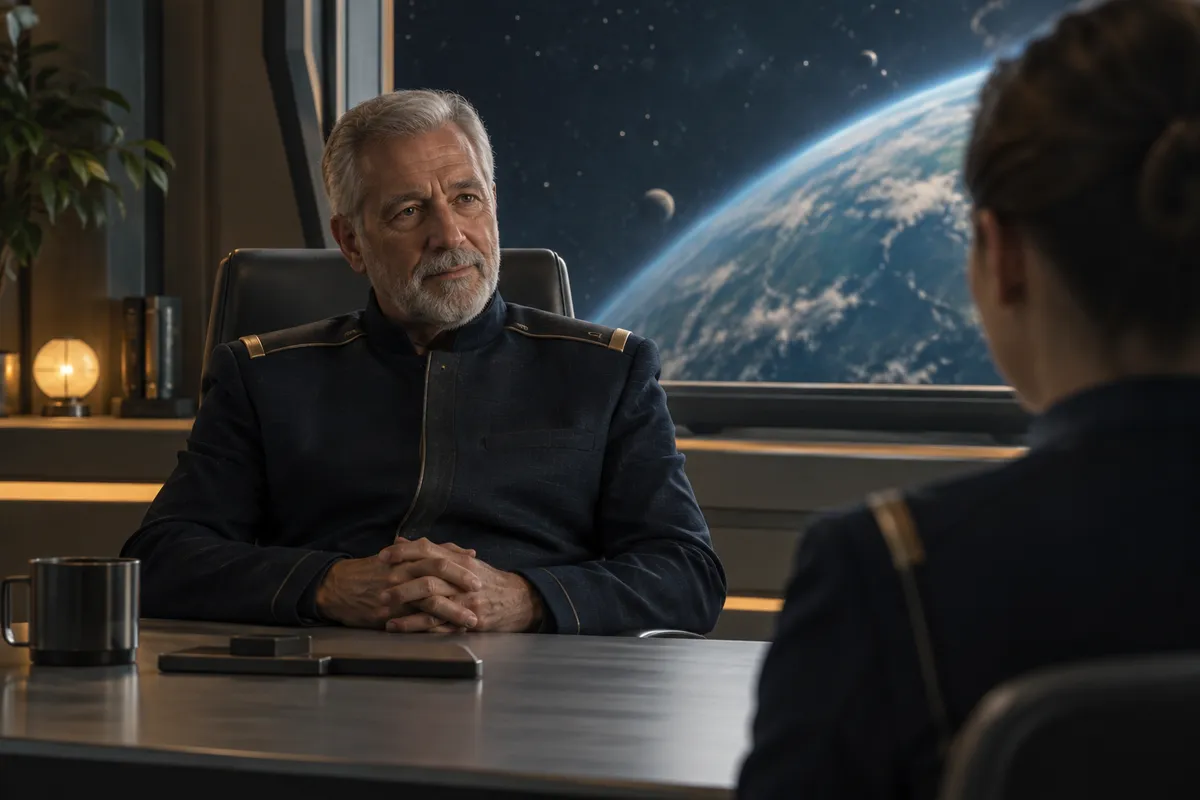
A new Boston Globe piece, written by two longtime Star Trek fans, makes a case that will sound familiar to anyone who grew up with Star Trek: The Next Generation: Patrick Stewart's Captain Jean-Luc Picard taught a generation what a good person looks like. The essay argues that Stewart made Picard more than a sci-fi icon. In the authors' telling, he became a teacher, a "Space Dad," and an enduring blueprint for principled adulthood.
The story was also making the rounds on the Hacker News front page, where it collected 264 points and 145 comments. When a tribute to a fictional starship captain pulls that kind of crowd on a tech-heavy forum, it suggests the character still hits a nerve.
The Anti-Antihero
Here's the angle worth chasing: Picard as the anti-antihero.
The Globe piece frames Picard as a model of moral clarity, vulnerability, and humane leadership. Think about how unusual that is against the TV landscape many of us have streamed for years, where the brooding, compromised, morally murky lead is practically a house style. Picard is the opposite. He is admirable on purpose, and the show trusts you to find that compelling rather than boring.
That's the quiet trick. A virtuous character is hard to write and harder to play, because goodness can curdle into smugness or stiffness. According to the Globe's authors, Stewart's performance is what kept Picard human. The vulnerability sits right next to the authority, and that combination is what turns a captain into something closer to a mentor.
Why the "Space Dad" Label Sticks
The Globe authors lean on the nickname "Space Dad," and it's easy to see why it fits. Picard leads by listening, by thinking out loud, and by admitting when the answer isn't obvious. It's hard not to read that as a deliberate counterweight to the louder, swaggering model of command that action-adventure TV has often favored.
That's my take, not the Globe's, but it explains the comfort-character effect. Comfort characters aren't always the funniest or the flashiest. They're the ones who make you feel that someone competent and decent is in charge, even if only for 45 minutes on a weeknight. For heavy streamers who rewatch old favorites on a loop, that's a real draw.
Why This Is Landing Now
The essay's timing matters. In what the piece describes as a polarized era hungry for trustworthy leadership and emotional honesty, Picard's ideals feel newly relevant. Audiences are also revisiting legacy characters who shaped their ideas of masculinity, duty, and integrity, and Picard sits near the top of that list.
It's worth separating what's reported from what's interpretation here. What's reported: two fans wrote a heartfelt argument that Stewart's Picard modeled truth, courage, and compassion. What's interpretation: that this explains the current appetite for such characters. The second part is a reasonable read of the moment, but it's a read, not a measured trend.
The Vulnerable-Masculinity Question
One thread in the Globe's framing deserves its own spotlight: Stewart's portrayal as a model of vulnerable masculinity. Picard is authoritative without being domineering, and emotionally honest without losing command. For viewers who found few examples of that on screen growing up, the character may have filled a gap.
That's also why the "measure of a man" idea in the headline works. Picard doesn't prove himself through winning fights. He proves himself through how he treats people, how he handles grief, and whether he'll tell the truth when it costs him. Those are the lessons the essay says viewers carried out of the show and into real life.
What to Do With This
If the essay stirs the itch, the move is obvious: pick a Next Generation episode that showcases Picard thinking through a hard call, and watch it with fresh eyes. The Globe authors argue the lessons about truth, grief, courage, and public life hold up. A rewatch is the easiest way to test that claim yourself.
And if you've never watched, this is a low-risk entry point. You don't need to know Klingon politics to understand a man trying to do the right thing and doubting himself while he does it.
The Bottom Line
Nostalgia pieces are cheap. The ones that land do so because the thing being remembered still works. The fact that a captain created for a 1980s-conceived future still gets 145 comments of earnest discussion says something: audiences haven't stopped wanting a leader who is kind, curious, and honest. Stewart gave them one, and by the Globe's account, we're still taking notes.